
Life imprisonment from young adulthood: a longitudinal follow-up study
Principal Investigator: | (University of Cambridge) |
|
|---|---|---|
Co-Investigators: |
| |
 |


In April 2020, we began working on a new ESRC-funded study of life imprisonment from a young age, building on findings from our earlier research, Experiencing Very Long-Term Imprisonment from Young Adulthood.
The study adopted a longitudinal perspective to follow-up more than 140 men and women first interviewed between 2013-14 about their experiences of being given very long custodial terms (minimum tariffs of 15 years or more) at a young age (25 years or younger). 120 men and women were interviewed for a second time, some of whom had been released into the community.
Briefly, the core objectives of the study are as follows:
- To detail the lived experience of a set of prisoners - and former-prisoners - about whom very little is known among practitioners and academics, and whose voices tend to be marginal in academic, policy and media discussions of new sentencing and punishment practices.
- To provide longitudinal insight into the experience and impact of long-term confinement from a young age, using both qualitative and quantitative research methods.
- To provide a nuanced and thorough examination of the ways in which individuals reflexively engage with their long life sentence and their murder conviction, and the ways in which such reflection is undertaken relationally (i.e. with others). This will involve a focussed interview technique, grounded in Archer's (2003, 2012) theoretical framework, exploring the specific ways in which individuals - both on their own and with various relational interlocuters - plan, rehearse, mull-over, decide, re-live, prioritise, imagine and hold imaginary conversations, relating to their personal projects and concerns.
- To explore the subjective experience of the distance and polarity between the prison and the outside world (‘depth’), drawing attention to the role of the prison in prisoners' life trajectories, and the existential meaning of such long-term sentences overall.
- To examine the experience of release from a long-life sentence, including the transition from custody to community, sources of hope, control and meaning, the impact of long-term custody on subjectivity, identity and relational life post-release, and the ongoing relationship between the institution of imprisonment and the society in which it is embedded.
We also aim to contribute to policy and practice in relation to long term and life imprisonment, specifically by using empirically grounded evidence to inform policy makers and senior HMPPS officials about how the identities, orientations, preoccupations and needs of this population change during their sentences, and the impact of different prison environments on their personal trajectories within and beyond the prison.
A second open-access book detailing the study should be completed by mid 2027.
Dissemination activities:
In conjunction with two graphic designers, we developed two small graphic comic-style booklets, aimed at newly life-sentenced prisoners (one for men, one for women), which represents the journey of a ‘lifer’ as described through participants in Experiencing Very Long-Term Imprisonment from Young Adulthood.
We featured on two guest episodes of the Secret Life of Prisons podcast on life imprisonment, in conjunction with the Prison Reform Trust and the Prison Radio Association.
We produced a video, featuring extracts from our interviews voiced by actors, which tries to convey the inner lives of men and women serving life sentences. This is mainly aimed at prison staff.
List of publications fromExperiencing Very Long-Term Imprisonment from Young Adulthood:
Monographs:
| Crewe, B., Hulley, S. and Wright, S. (2020). Life Imprisonment from Young Adulthood: Adaptation, Identity and Time. London: Palgrave Macmillan. | 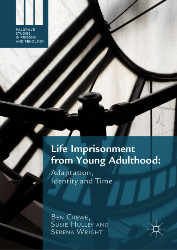 |
The book has been reviewed in a number of journals, including: Kriminologie - Das Online-Journal; Theoretical Criminology; Punishment & Society; Social & Legal Studies, and the British Journal of Criminology.
Peer-reviewed papers and chapter:
Hulley, S. (under review) The moral weight of murder.
Crewe, B. (2024). ‘Sedative Coping’, Contextual Maturity and Institutionalization Among Prisoners Serving Life Sentences in England and Wales’. The British Journal of Criminology, 64 (5) p1080–1097
Wright, S., Hulley, S., and Crewe, B. (2021). The pains of life imprisonment during late adolescence and emerging adulthood. In The Palgrave International Handbook of Youth Imprisonment (pp. 479-501). Springer International Publishing.
Hulley, S., Crewe, B. and Wright, S. (2019). Making sense of ‘Joint Enterprise’ for murder: legal legitimacy or instrumental acquiescence?British Journal of Criminology, 59(6), 1328-1346.
Crewe, B., Hulley, S. and Wright, S. (2017). The gendered pains of life imprisonment, British Journal of Criminology, 57(6), 1359-1378.
Crewe, B., Hulley, S. and Wright, S. (2017). Swimming with the tide: adapting to long-term imprisonment, Justice Quarterly, 34(3), 517-541.
Wright, S., Crewe, B. and Hulley, S. (2016). Suppression, denial, sublimation: Defending against the initial pains of very long life sentences, Theoretical Criminology, 21(2), 225-246.
Hulley, S., Crewe, B. and Wright, S. (2016). Re-examining the problems of long-term imprisonment, British Journal of Criminology, 56(4), 769-792.
Analytical summaries and other non-peer reviewed publications
Crewe, B., Hulley, S. and Wright, S. (2019). Long-term imprisonment from young adulthood (National Offender Management Service Analytic Summary 2019). London, UK: HMPPS / Ministry of Justice.
Crewe, B., Hulley, S. and Wright, S (2019). What should happen to people who commit murder? In A. Fox and A. Frater (Eds.) Crime and Consequence: What should happen to commit who commit criminal offences? (pp.281-287). London, UK: CLINKS / Monument Trust.